


Have you ever gone thru-hiking for the solitude of nature, only to find you can’t escape the crowds on some popular trails? We here at thru-r know those desires and challenges, too. That’s why we are kicking off this blog series on lesser-hiked trails. You can get out for a shorter thru-hike that will balance your desire for peace in nature with your desire for companionship!
The Hebridean Way
Fast facts:
- Location: Outer Hebrides of Scotland
- Distance: 156 miles (251 K)
- Elevation: sea level to 880 feet (270 m)
- Usual time length:10-14 days
- Best time to hike: May to September
- End points: Island of Vatersay to Stornoway on the Isle of Lewis
- Traditional direction: South to North
- Terrain: Paved roads, trails, boggy moorland, machair, beaches and dunes, and dirt farm roads
- Longest resupply carry: 2-3 days max
- Unique features: 10 islands traversed with 6 causeways and 2 ferry rides between islands, plus the ferries to and from the island chain
- Challenges: midges, strong coastal winds, wayfinding on boggy moors
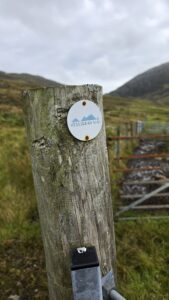
- Navigation: Visit Hebrides website has detailed directions with stages and maps but is not GPS compatible; Walk Highlands has similar information, but can be linked to GPS
- Getting there: Bus or train north to Fort William then bus to Oban and ferry to Castlebay
- Getting back: Ferry ride to Ullapool then bus to Inverness; bus or train to points south
 What to expect
 What to expect
Physical features
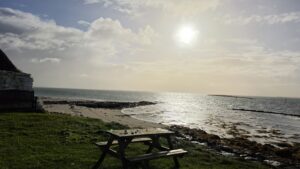
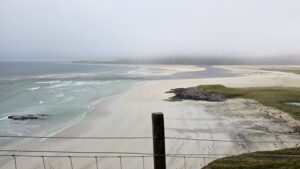
This was a gorgeous hike! I saw tons of sheep and cattle, ruins, lochs, and open landscapes. And so many birds! Geese, ducks, swans, plovers, golden eagles, falcons and many others. Water is everywhere, from the ocean and Inner Seas, to the rivers and lochs. At least one body of water was always visible. Some of the islands seem to be more water than land. You cross narrow causeways; ride a few ferries; walk along single-wide back roads (with turnouts for passing vehicles); squelch through moors up to your calves and knees at times; and walk along pristine, wild beaches and dunes.
Weather
Strong winds blow off the Atlantic and the barren landscape has few trees to shield you. It is often wet and rainy. I had only a few sunny days on my 12 day journey, and even those had a few sprinkles. Be sure your rain gear is up to snuff and your tent can withstand strong winds. A dry sack inside your pack is a must. I wore rain pants, a raincoat, and Sealskinz socks because my feet were perpetually wet. The wind was too strong for my umbrella most days. I used my Durston Xmid 1 without issue, even when I was less than 50 feet from the ocean.
The winds and rain kept the midges at bay, though. I only used Smidge once. I did not see any gear stores on the journey, so be sure to outfit yourself appropriately before you arrive. Resupply was easy every few days, though, with the numerous village shops. I eat a vegetarian diet and had no trouble finding several food choices in the shops or restaurants.
Lodging and camping
Most villages had some lodging options, but even in September, they were often booked. I did a mix of hostels, hotels, campgrounds, and wild camping. Fortunately, in Scotland, you can wild camp anywhere with a few caveats. You must practice Leave No Trace and cannot camp in an enclosed field; or near buildings, roads, or historic structures (ruins). Check out Visit Scotland for all the details.
The Highs and Lows
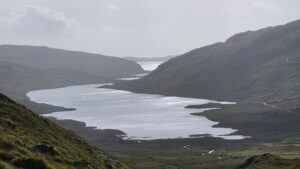 The highs were definitely the views, the wildlife, and the sheer ruggedness of these Scottish islands. All of the villages were small until Stornoway. That was a city, but a really, really small city. The whole chain of islands is sparsely populated. This made for very friendly islanders. They are welcoming and genuinely want to help you enjoy your time in their home. The only downside of that is the lodging is often booked up if you want a shower or to get out of the rain to dry your gear.
Most of the time, I was walking alone. And I loved that! I saw plenty of people in villages and campgrounds to satisfy my social needs. I met several cyclists doing the bike trail, but only four other hikers. All of us were hiking the Hebridean Way. And I only saw one of them a second time. I met one additional couple who were out walking a few miles along a loch one day near the end of my journey. That was it. Overall, this was the perfect balance for me. I was able to talk to a few people every day, but I also had hours alone.
 Another highlight was the light food bag I carried. With so many villages to walk through, I was able to carry less than 2 days supply. I was able to get inexpensive hot meals in most villages, and cooked at hostels and campground kitchens for the others. I probably could have left my stove home because I did not use it once. Additionally, no big game animals meant no need for a heavy bear canister. The scarcity of trees meant I could not hang my food. I used my Ursack to keep my food safe from other critters. I was never far enough away from civilization that I needed to collect water or filter from these natural bodies. I was able to get water several times every day from clean sources.
The Lows
As much as I loved the trail, I could have done without the moors. This was very wet, very difficult, very slow walking for several miles at a time. I used my trekking poles to poke around in front of me to find solid enough ground to step on. Sometimes, my pole went almost down to the handle before I pulled it out of the mud and muck. Sometimes, I did not put my foot in precisely the location I had found stable with my pole, so I sunk down well past my ankles. Those steps almost took my shoes!
I almost fell several times every mile, and completely ended up on my rear several more. After the first day, which was sunny, I wore my rain pants and Sealskinz every day because of the rain, the muddy trail sections, and the mucky, trailless moors. The moorlands had trail markers frequently enough, but no actual trail. Each traveler picks their own path, with only a few boardwalks and bridges over the thickest and largest muddy sections. These sections of moorland were beautiful, but the most challenging aspect of this adventure. After a few days, I often chose to road walk over squelching though the moors.
Key take-aways
- Hike for the ruggedness and peaceful seclusion. This trail is great if you crave time alone but welcome visiting with a few people most days.
- Resupply is easy, but new or replacement gear is difficult.
- Be prepared for the moors, the weather, and the midges. I understand the summer is sunnier but the midges are worse.
- Tour busses and campervans abound. Tourists flock to the islands in summer, so it will likely be busier then.