


Cover photo courtesy of the Appalachian Trail Conservancy
I’m doing something new-to-me this summer. After my LASH on the Continental Divide Trail (CDT), I’m heading up to Montana to join a trail maintenance crew! If you’ve thru-hiked before on one of our National Scenic Trails, you have likely run across these angels of the trails. You may have come across them even on shorter hikes. As hikers, we benefit so much from the work of these crews, I wanted to give back and tell you how you can be involved, too!
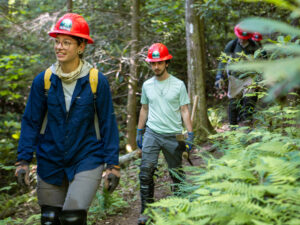
Photo courtesy of the Appalachian Trail Conservancy
Trail Maintenance Crews
So, what are trail maintenance crews? How are they formed? What qualifications do they have? How can I join in the fun?
I’m glad you asked!
Trail maintenance crews are the people who clear debris like fallen trees, overgrown brush, and weeds that encroach on the trail. They maintain accurate trail blazes or markers, add rock or log steps, line the edges of the trails with rocks, create boardwalks for marshy ground, build cairns (when necessary), add safety handholds, and other physical features that make the trail safer and reduce the impact on the local ecosystems. The vast majority of these crews are trained volunteers. Depending on the trail and the work required, they also hire qualified individuals to engineer and supervise the installation of the physical features.
The Big Three Trails
Most of the National Scenic Trails have someone on staff for their non-profit organization who manages these volunteer crews. A few trails rely on volunteers from the National Park Service. Some of the crews are formed and managed by local outdoors or hiking clubs, like on the Appalachian Trail (AT). But even then, the work of the clubs is overseen by the governing organization. To join in with a crew, you need to check out the website for that trail’s organization. For example, when I signed up to work on the CDT, I went to the Continental Divide Trail Coalition website and looked up volunteer opportunities. I contacted ATC, CDTC, and PCTA to get trail specific information at a glance for you, too.
Appalachian Trail Conservancy
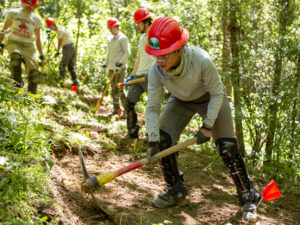
Photo courtesy of the Appalachian Trail Conservancy
This is one of our nation’s oldest trails and the longest hiking-only trail in the world. This year, the trail stretches 2,197.9 miles from Georgia to Maine. The Appalachian Trail Conservancy (ATC) is the non-profit that protects, supports, and maintains the trail. Their efforts are supported by many local trail clubs, too.
I wrote to Jessie Johnson, the Volunteer Engagement Specialist at the Appalachian Trail Conservancy, this spring. She responded, “ATC hosts two volunteer trail crews – the Konnarock Crew from April – August and the Mid-Atlantic Crew from August – October. These crews work on important trail projects that keep the trail in great shape – anything from building new trail to repairing bridges and boardwalks. Crew sessions run from 3-8 days and no experience is needed – just a willingness to learn, work hard, get dirty, and have fun! All meals, lodging (camping, hostel, or basic cabins, depending on the session), training, and gear are provided. You can learn more here.”
She also noted that individuals who want to support the trail with a shorter time commitment or a more local location could contact any of the local A.T. clubs who host work crew days. She said interested people can search by location, type of volunteer work, and date using this link: Volunteer Engagement Platform.
Continental Divide Trail Coalition
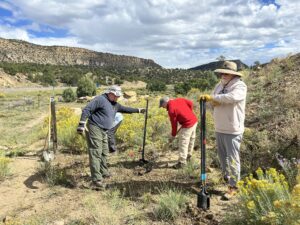
Photo courtesy of Continental Divide Trail Coalition
The Continental Divide Trail runs from Mexico to Canada crossing through New Mexico, Colorado, Wyoming, Idaho, and Montana. This “brutal” trail has many alternates, making it a choose-your-own-adventure thru-hike. Depending on the paths the individual hiker chooses, the trail is between 2,600-3,100 miles long. This trail is managed by the Continental Divide Trail Coalition (CDTC).
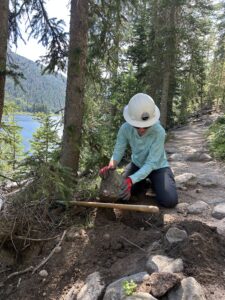
Photo courtesy of the Continental Divide Trail Coalition
I’ve been messaging with the Director of Communications, Audra Labert, at the Continental Divide Trail Coalition recently. She will be working on the crew with me later this summer and was excited to pass along information about volunteering for the trail. She said their volunteer opportunities are available for all experience levels and abilities. In fact, no prior experience is necessary and the staff on-site will teach and train you for your project. And, they “… work closely with partners to ensure that our work meets the standards applied across the National Trail System. Participants can expect to learn how to use common trail maintenance tools safely, and also proper techniques for trail maintenance and design. Each project has unique attributes and physical demands, so CDTC also tries to prepare and inform volunteers to have a safe and enjoyable project. And, each project affords opportunities to enjoy the landscape on their own….”
The CDTC has opportunities that can accommodate various schedules from day hike events to weekend trail stewardships to multiday backcountry excursions. They also have Adopt-a-Trail and Crew Chef programs for those who want longer-term or recurring opportunities. They have specialized training just for those programs to equip volunteers with the skills to be successful. The Adopt-a-Trail and Crew Chef trainings occur over a long weekend and prepare volunteers to work on a continuous (Adopt-a-Trail) or recurring (Crew Chef) basis. To get started on any of the CDTC volunteer opportunities, visit the CDTC Volunteer Web Page for more details and complete their Volunteer Interest Form so that the staff can help guide you to the opportunities with the best fit.
Pacific Crest Trail Association
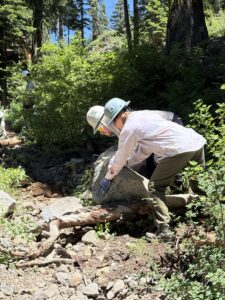
Photo courtesy of the Pacific Crest Trail Association
The Pacific Crest Trail is another one that stretches from Mexico to Canada, but it runs along the three west coast states of California, Oregon, and Washington for 2,650 miles. You need a permit for you to start this trail, or try your luck at getting a scattering of permits for different sections. The Pacific Crest Trail Association is the non-profit protecting and maintaining this trail. I know the least about this trail, just because I haven’t experienced any of it, yet. It’s on my radar for 2028, though!
The information provided by Amy Calvilllo Aubin, the Associate Director of Volunteer Programs, was most helpful on how their organization works to improve and maintain the trail with a volunteer corps. Volunteers can commit to a single day of trail work during their thru-hike or return to the trail to join a longer project after finishing a hike. You can sign up to volunteer with the PCTA on this registration page. Create a profile on the PCTAConnect platform and then check the project schedule for opportunities that fit your travel plans! Amy said, “Many thru-hikers find that spending even one day maintaining the trail gives them a deeper appreciation for the work that goes into keeping the PCT open and enjoyable for everyone.”
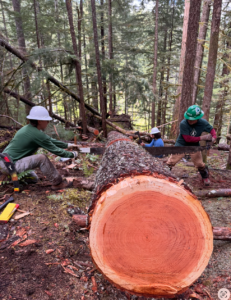
Photo courtesy of the Pacific Crest Trail Association
Other National Scenic Trails
Don’t forget the other National Scenic Trails. They need some love and support, too! I’ve listed some general information and links for these trails that might be helpful if you live nearby, or are planning to visit and want to volunteer.
The Arizona Trail (AZT) is 800 miles of trail heading north from the Mexico border. The Arizona Trail Association (ATA) is the governing body that maintains and protects that trail. You can find out how to volunteer here.
The Florida Trail (FT) is 1,500 miles of trail that runs from Big Cypress National Preserve near the base of Florida up through the panhandle. The Florida Trail Association (FTA) manages this trail, as well as other hiking trails in Florida. Their volunteer page gives information on how, when and where to volunteer for the trail system.
The Ice Age Trail (IAT) stretches 1,200 miles across Wisconsin following the glacier edge of the last ice age and is one of the more recent additions to the National Scenic Trails. The Ice Age Trail Alliance (IATA) is the non-profit that protects, builds, and maintains this trail. You can become part of a trail crew by following this link.
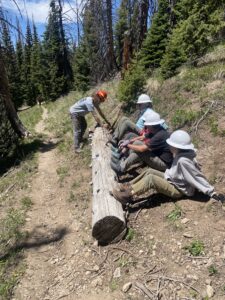
Photo courtesy of the Continental Divide Trail Coalition
The Natchez Trace (NT) is a trail that crosses Alabama to Tennessee for 444 miles and follows the routes of early Native Americans and early American settlers (but only about 70 miles of trail is completed). The Natchez Trace Parkway Association is the non-profit that works to maintain and promote the National Scenic Trail and the Natchez Trace National Park as a whole. Volunteering for this trail is a bit different in that you work as a National Park Service volunteer instead of the non-profit organization.
The New England Trail (NET) goes 235 miles from Long Island Sound in Connecticut to the Massachusetts/New Hampshire border. This is another newer National Scenic Trail and their non-profit organization is the NET. You can find information on volunteer opportunities here.
Another newer National Scenic Trail, the North Country Trail (NCT) stretches 4,800 across the eight northern border states from Vermont to North Dakota. Most of the trail work is managed by local chapters and affiliations of the North Country Trail Association. Learn more about volunteering along this majestic trail here.
The Pacific Northwest Trail (PNT) travels 1,200 miles from Glacier National Park in Montana across the northern border to the Washington coastline. The Pacific Northwest Trail Association builds, maintains, and protects this trail through rugged backcountry. This page has information on how, when, and where to volunteer on this National Scenic Trail.
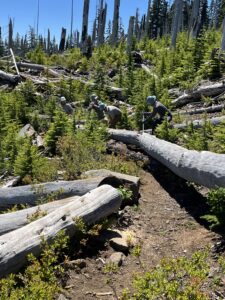
Photo courtesy of the Pacific Crest Trail Association
The Potomac Heritage Trail (PHT) is a disjointed series of hiking trails across northern Virginia, Washington, D.C., Maryland, and southwest Pennsylvania with much of the focus on U.S history. The National Park Service has oversight of this trail, but several local organizations manage volunteers.
An organization that helps support all of the trails in the National Trail System across all 50 states is the Partnership for National Trail System (PNTS). This includes all 11 National Scenic Trails I’ve detailed here, plus 21 National Historic Trails and 1,300 National Recreation Trails.
Other Trails
Although they are not National Scenic Trails, the U.S. has many other notable and popular long trails, including Vermont’s Long Trail, the Benton MacKaye Trail, the John Muir Trail, and the Maah Daah Hey Trail. Many other long trails also have local organizations that manage trail maintenance and volunteers. Check with your local trail clubs or the trail organization for the specific trail you want to support!
Thanks GG! I’ve been wanting to volunteer but didn’t really know where to start. This is a great resource!
This is wonderful, GG! We as hikers truly need to do our part in order to keep the trails as accessible as possible.
I love this and would love to be able to help support the trails more. Thanks GG for your insight and information on how to engage with the trail organizations.